


Day.1. Ende Airport – transfer to Moni
Upon arrival at Ende airport our team will meet you than drive to Moni
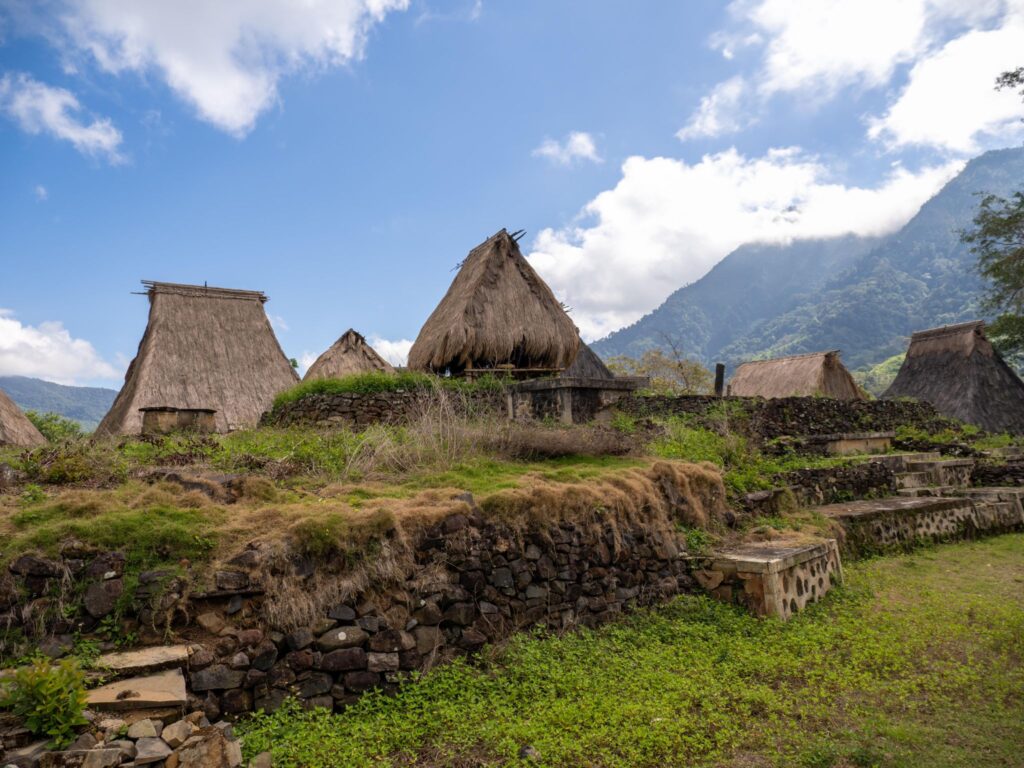
On the way visit saga traditional village from Lio tribes.
Saga Village (Kampung Adat Saga) is a traditional highland settlement known for its preserved culture and stunning views. Here is a brief overview in English:
The village is famous for its Sao Ria (traditional houses) built on tiered stone platforms. These wooden structures with high, thatched roofs are arranged according to ancient social hierarchies and surround a central ritual courtyard.
Unlike many coastal attractions, Saga is perched on a hilltop. This location offers a 360-degree panoramic view of the surrounding lush valleys, distant mountains, and the southern coastline of Flores.
Saga is not a museum; it is a living community. The Lio people here maintain their ancestral customs, including:
Ikat Weaving: Local women often demonstrate the intricate process of creating traditional Lio textiles.,
Pati Ka: A ritual of feeding the ancestors.
Detuzoko viewpoint of rice field
arrival at Moni direct see the water fall and check in hotel
Day .2. Moni – Kelimutu lake – Bajawa
Morning at 4.30am drive to kelimutu lake parking the start trekking until top to enjoy spectacular sunrise and color lakes
It is famous for its three volcanic crater lakes, each featuring a different color.
The most unique feature of Kelimutu is that the lakes change colors periodically. While they are often turquoise, olive green, and dark red, they have been known to turn white, blue, or even chocolate brown. This phenomenon is caused by subaqueous volcanic activity and changes in the oxidation-reduction status of the lake fluid.
The local Lio people believe the lakes are a resting place for the souls of the dead:
- Tiwu Ata Mbupu: The lake for the souls of the elderly.
- Tiwu Nuwa Muri Koo Fai: The lake for the souls of young people.
- Tiwu Ata Polo: The lake for “bewitched” or evil souls.
The best way to experience Kelimutu is to hike to the summit (Inspiration Point) before dawn. Watching the sunrise reveal the vibrant colors of the lakes as the mist clears is considered a spiritual and bucket-list experience for many travelers.
Breakfast at hotel than drive to Bajawa
Stop at Blue stone beach
viewpoint of Ebulobo volcano from the road
Soa hot spring than check in hotel in Bajawa
Day. 3. Bajawa – Ruteng
Breakfast than drive to see traditional village of Bena
The village consists of two parallel rows of high-thatched, traditional houses called Bhaga and Ngadhu. These structures represent the ancestral spirits of the local clans, symbolizing the balance between male and female elements.
In the center of the village, you will find ancient stone formations used as altars for sacrifices and traditional ceremonies. It feels like stepping back in time to the Stone Age.
Unlike a museum, Bena is a living community. You can see the local women sitting on their porches weaving beautiful Ikat (traditional hand-woven cloth), which you can purchase directly from them as a souvenir.
Built on a hilltop, the village offers a dramatic backdrop. If you walk to the very end of the village (the “viewpoint”), you get a breathtaking view of the Mount Inerie volcano and the lush valleys leading down to the Savu Sea.
Arak/local drink process at Aimere
Rana mese freshwater lake
golo curu hill for viewpoint of ruteng town and around, check in hotel
Day. 4. Ruteng city tour
visit liang bua cave/hobbit cave to see homo floresiensis fossil
Trekking through the rice field
Ruteng puu traditional house
local market of ruteng, than check in hotel
Day.5. Ruteng – Labuan Bajo
Breakfast at hotel drive to Labuan bajo, stop at spider web rice field
The spiderweb rice fields are one of the most unique agricultural sights in the world. Locally known as Lingko, these fields are located in Cancar, near Ruteng, Manggarai Regency.
Unlike traditional square or terraced paddies, these fields are laid out in a circular pattern that resembles a giant spiderweb. When viewed from a high vantage point, the radiating lines and concentric circles create a stunning geometric landscape.
The shape is not just for aesthetics; it is rooted in the Manggarai tradition.
- The land is divided among different families or clans from a central point called the lodok.
- The size of each “slice” of the pie depends on the social status and number of families within the community.
The center of the web (the lodok) is considered a sacred spot where rituals and offerings are held to ensure a bountiful harvest and to honor the ancestors. It symbolizes the unity and connection between the community members.
To see the full “spiderweb” effect, travelers usually hike up a small hill in Cara Village. From the top, you can see several large Lingko fields spread across the valley, especially vibrant and green during the growing season.
Melo viewpoint
Batu Cermin cave than drop off at hotel
For boat Trip is optional or lets me know on request we can arrange it too